Vanel Ngansoo, Chartered Professional Engineer, Professional Engineers of Ontario
March 19, 2026
Share article



Roads are among the oldest and most fundamental infrastructures of human societies. In contemporary Africa, they remain central to development strategies, opening up isolated areas, and economic integration. Yet, despite decades of sustained investment by states and technical and financial partners, a significant portion of the African road network continues to deteriorate prematurely.
This article offers an analytical and narrative perspective on this situation, demonstrating that the problem extends beyond mere issues of financing or governance to encompass a historical and technical continuum. The choice of road materials, far from being neutral, emerges as a determining factor in the economic and structural performance of infrastructure.
Modern road infrastructure in Africa has its origins in the colonial period. At that time, roads were not
conceived as a tool for endogenous development, but rather as a logistical instrument intended to connect agricultural and mining production areas to ports and administrative centers. This export-oriented approach to road design profoundly shaped the initial road networks.
The pavement designs imported from Europe were based on unsuitable climatic and mechanical assumptions: moderate temperatures, limited traffic, and regular maintenance. Asphalt, widely used in temperate countries, was introduced without significant adaptation to African conditions.
After independence, this technical framework was not fundamentally challenged. Faced with the urgent need to overcome landlocked conditions and limited institutional capacities, African states maintained inherited standards, creating a historical continuity whose effects are still felt today.
Roads are a central instrument for economic structuring. In Africa, they have historically served to support export economies, linking production basins to seaports and international corridors.
This approach has favored extraction routes at the expense of development routes, intended for territorial integration and internal mobility. The technical choices made have thus prioritized speed of execution over sustainability.
Roads are also political objects, embodying visible public action. This symbolic dimension has sometimes reinforced a short-term approach, focused on the delivery of projects rather than their long-term performance.
Asphalt has gradually become the standard material for road construction in Africa, not as a result of a technical choice based on a rigorous assessment of local constraints, but rather due to established norms and institutional practices. Its initial adoption was driven by operational criteria deemed advantageous: speed of execution, relative simplicity of implementation, and suitability for contractual frameworks focused on short-term objectives.
This technical model, largely imported from Western practices, has been maintained without significant adaptation, even though the countries of origin of these standards have, over time, developed solutions better suited to their own climatic and structural constraints. In Africa, however, the mastery of technical specifications and design choices has remained largely dependent on external frameworks.
Public procurement mechanisms have also played a decisive role in this dominance. The evaluation of bids still relies primarily on the initial cost, to the detriment of analyses that incorporate the overall cost over the life cycle of the infrastructure. This approach mechanically favors solutions that appear economically attractive in the short term, but whose long-term performance is insufficient.
Furthermore, the limited capacity of contracting authorities to closely control local specifications, quality of execution and conformity of works has reinforced a logic of dependence on the results presented by construction companies. In this context, asphalt has become the norm through institutional inertia, rather than through scientific demonstration of its suitability to African conditions.
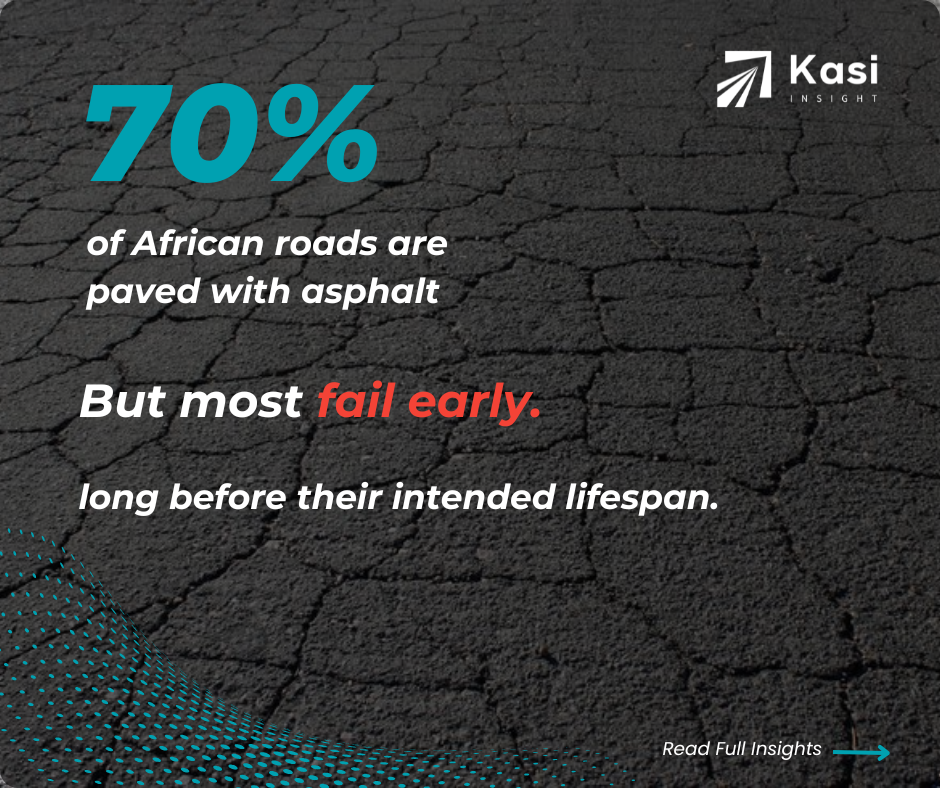
From a technical standpoint, climate is one of the fundamental parameters in road design. However, in many African projects, actual climatic constraints have long been underestimated, either through the imposition of imported standards or through an overly theoretical interpretation of environmental data. This underestimation has direct consequences for the durability of the structures.
In much of the African continent, air temperatures regularly exceed 40°C, while road surface temperatures can reach, or even exceed, 65 to 70°C[1]. These values are not exceptional but recurring and should be considered normal operating conditions. However, the design assumptions used in many projects often remain based on more moderate thermal ranges, which are unsuitable for local realities.
In addition to this thermal stress, there is the chronic overloading of heavy vehicles, frequently observed on African road networks. Axle loads regularly exceed regulatory limits, which increases the mechanical stresses on pavement structures. When these loads are applied to a material already weakened by heat, the degradation processes are significantly accelerated.
Water is the third aggravating factor. Episodes of intense rainfall, combined with drainage systems that are sometimes inadequate or poorly maintained, promote water infiltration into the pavement layers. The interaction between heat, overload, and water represents one of the most unfavorable scenarios for the durability of road infrastructure. This reality necessitates a design approach that explicitly integrates these three parameters, rather than treating them as secondary factors.
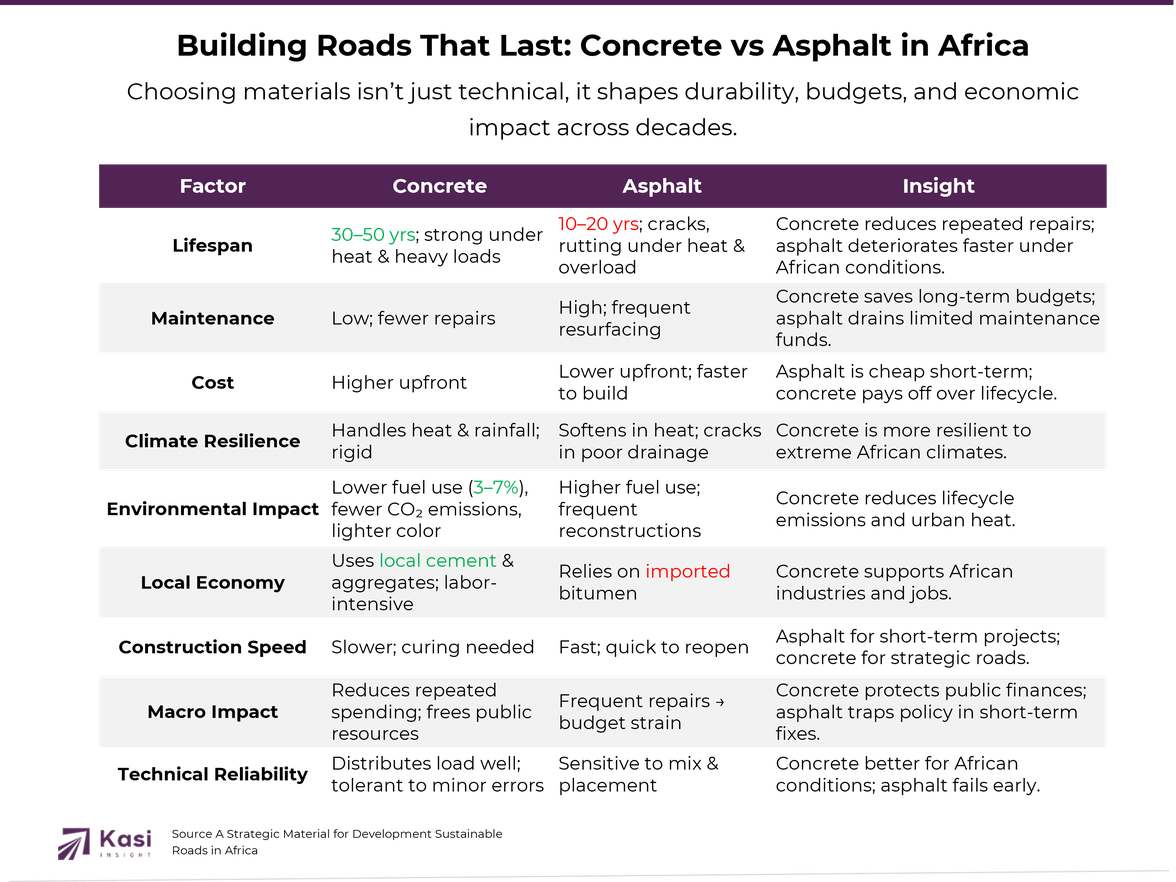
A comparative analysis of asphalt and concrete pavements reveals fundamental differences in mechanical behavior. Asphalt is a viscoelastic material whose properties vary depending on temperature and the duration of stress. Under high temperatures, its rigidity decreases, making it particularly susceptible to permanent deformation under traffic.
In African conditions, this behavior manifests as rutting, creep, and premature cracking. These problems do not necessarily result from poor workmanship, but often from a mismatch between the intrinsic properties of the material and the actual operating conditions. Even when correctly formulated and applied, asphalt remains structurally vulnerable when temperatures and loads exceed design assumptions.
Concrete exhibits fundamentally different mechanical behavior. As a rigid material, it retains most of its mechanical properties over a wide temperature range. Its high compressive strength allows it to better distribute loads to the foundation layers, thus reducing internal stresses and permanent deformations.
Another crucial aspect is sensitivity to execution errors. Asphalt pavements are highly dependent on placement conditions, including laying temperature, compaction, and mix formulation. Even slight variations can significantly impact durability. Concrete, while requiring rigorous execution, generally offers greater tolerance to operational variations, which is an advantage in contexts where quality control may be inconsistent.
Economic analysis of road infrastructure confirms previous technical findings. In several West and Central African countries, the initial cost of constructing one kilometer of road is comparable to, or even higher than, that observed in developed countries. Yet, the actual lifespan of this infrastructure is significantly shorter.
This situation reflects a poor consideration of life-cycle costs. Decisions are often driven by initial costs and immediate budgetary constraints, without factoring in future costs related to maintenance, rehabilitation, and service interruptions. This approach leads to choices that appear economically rational in the short term but prove detrimental over several decades.
Conversely, countries that have adopted a life-cycle approach, such as Canada, accept sometimes higher initial costs in exchange for a longer service life and controlled maintenance costs. This approach allows for the smoothing of expenses over time and reduces long-term budgetary pressure.
For a civil engineer, the conclusion is clear: the "cheapest" criterion only makes sense if it is evaluated over the actual lifespan of the structure. Without this analysis, road investments risk becoming a permanent source of budget imbalances.
Concrete pavements offer significant environmental benefits compared to asphalt pavements. Their greater rigidity reduces deflection under traffic, which decreases vehicle fuel consumption by approximately 3 to 7% compared to an asphalt road[2]. On a macroscopic scale, the widespread adoption of more rigid pavements could thus substantially reduce CO2 emissions from road transport[3].
Furthermore, the superior durability of concrete – with a lifespan of up to 50 years and much less frequent maintenance requirements – implies fewer reconstructions and works over time. This results in a reduced overall ecological footprint, despite a higher initial energy cost for cement production, because the entire life cycle is optimized[4].
In addition, the lighter color of the concrete reduces the absorption of solar heat, mitigating the urban heat island effect, and improves nighttime visibility on roads, which can contribute to road safety[5].
The analysis of the role of construction companies must be conducted with rigor and objectivity. On the ground, it is clear that companies, whether local or international, operate within a specific contractual framework. Their mission is to execute the work in accordance with the technical specifications, deadlines and budgets defined by the client.
These companies operate according to a rational logic of profitability. They optimize their methods to meet contractual requirements and limit financial risks. It is not their role to define national infrastructure policy or to choose materials based on macroeconomic or climatic considerations.
The contract should therefore not be confused with the national strategy. When specifications implicitly favor certain technical solutions, companies comply. Expecting them to correct, through their own choices, absent or inappropriate strategic decisions is a confusion of roles.
The responsibility for choosing materials clearly lies with the States and contracting authorities. They are the ones who define the standards, evaluation criteria, and sustainability objectives. When these frameworks are insufficiently long-term oriented, the results observed on the ground are a direct consequence.
The structural limitations of asphalt pavements call for a reconsideration of the materials used. Concrete then appears as a coherent response to the identified climatic, technical and economic constraints.
Concrete is a composite material made from a mixture of cement, aggregates, and water, whose strength results from an irreversible hydration process. Its key mechanical property is its high compressive strength.
This resistance gives concrete pavements a high load-bearing capacity, particularly suited to contexts of overload and high temperatures.
Concrete relies on inputs that are widely available locally. Africa now has a robust cement industry, with major players such as Dangote Cement, CIMAF, Lafarge-Holcim, PPC Ltd., Bamburi Cement and Ghacem[6].
Concrete construction is more labor-intensive, promoting employment and the development of local skills.
Its thermal stability and durability allow for heritage management of infrastructure, breaking with the logic of permanent reconstruction.
Canada is a particularly relevant case study, not because it shares the same climatic conditions as Africa, but precisely because it has adapted its technical choices to extreme environmental constraints. Canadian climates, characterized by repeated freeze-thaw cycles, very low winter temperatures, and significant temperature variations, place considerable stress on road infrastructure severe, comparable in intensity — although different in nature — to those observed in hot African climates.
Faced with these constraints, Canada has gradually developed a culture of sustainability based on experience, operational feedback, and rigorous analysis of actual pavement performance. Failures observed in infrastructure designed without adequate consideration of climatic conditions have led engineers and public authorities to thoroughly review their approaches. This evolution has resulted in a shift from a focus on initial cost to one of long-term performance.
In Canadian practice, road infrastructure design is based on life-cycle standardization. Materials and structures are evaluated not only on their construction cost, but primarily on their service life, maintenance requirements, and performance under real-world operating conditions. This approach naturally leads to a preference for more sustainable solutions, even when their initial cost is higher, provided their overall cost over several decades is lower.
The use of concrete pavements for major roads, highways, and areas subject to high stress illustrates this philosophy. Concrete is used not as a universal solution, but as a targeted technical response to specific constraints: heavy loads, significant temperature variations, and high demands for infrastructure availability. This choice results from an accumulation of field data and technical analyses, rather than a theoretical preference.
The value of the Canadian case for Africa lies precisely in this methodological approach. It is not a matter of mechanically transposing solutions designed for cold climates, but of adopting the same rigor in analyzing local constraints. Just as Canada has integrated freeze-thaw cycles as a central design parameter, African countries must integrate extreme heat, vehicle overloading, and hydrological variability as fundamental data, not as secondary factors.
Another key lesson from the Canadian model concerns the relationship between engineering and public policy. Technical choices are largely supported by clear regulatory frameworks, evolving design guidelines, and close collaboration between engineers, government agencies, and research organizations. This integration allows for continuous improvement of practices, based on observations of the actual performance of infrastructure in operation.
Finally, the Canadian experience shows that infrastructure sustainability is not a luxury reserved for advanced economies, but an economic necessity. Investments in more robust infrastructure are justified by the reduction in service interruptions, maintenance costs, and premature reconstructions. This logic is fully applicable to African contexts, where budgetary constraints are more limited and where every technical failure has amplified economic and social repercussions.
Thus, Canada is less a model to imitate than a benchmark for reasoning. Its experience demonstrates that engineering based on a thorough understanding of climate constraints, life cycle analysis, and long-term planning makes it possible to build resilient infrastructure that is adapted to its environment and economically sound.
For Africa, the challenge is not to import solutions, but to adopt this same logic of responsible and contextualized engineering.
As a civil engineer, it is clear that the choice of road materials cannot be analyzed solely from the perspective of initial cost or ease of execution. This choice directly and measurably determines the overall economic performance of infrastructure and has lasting macroeconomic effects on public finances and the national economy.
When a material whose actual durability is less than the climatic and operational constraints is chosen, the first observable consequence is an increase in the number of rehabilitation operations. From a technical point of view, these repeated interventions reflect a discrepancy between the design assumptions and the actual service conditions.
From an economic point of view, they translate into a continuous mobilization of budgetary resources, often unforeseen, which transforms road maintenance into a succession of quasi-reconstructions.
In practice, these recurring expenses end up absorbing a significant portion of infrastructure budgets. States find themselves forced to reinvest in recently completed sections, instead of expanding the network or improving the quality of existing infrastructure. This phenomenon creates structural inefficiency: the invested capital does not produce the expected long-term results, and the socio-economic profitability of road projects declines sharply.
This situation has a direct impact on the sustainability of public finances. Repeated rehabilitations are generally not financed by current resources, but by new borrowing or by reallocating funds initially intended for other projects. At the macroeconomic level, the poor choice of materials thus contributes to a form of structural debt, linked not to the scale of the projects, but to their short actual service life.
From an economic engineering perspective, this dynamic leads to a clear crowding-out effect. The resources mobilized to repair deteriorated roads cannot be invested in other priority sectors such as education, health, energy, or water. The initial technical choice, seemingly limited to a road project, ultimately influences the overall allocation of public resources and, consequently, long-term development trajectories.
Furthermore, the premature deterioration of road infrastructure has indirect but measurable effects on economic productivity. A road in poor condition increases travel times, transport costs, and vehicle wear and tear. These additional costs are passed on to the
The price of goods and services reduces the competitiveness of businesses and the purchasing power of households.
In rural areas, the impact is even more pronounced: access to markets becomes irregular, which weakens agricultural value chains and exacerbates territorial disparities.
Beyond economic indicators, poor material choices also affect the perception of public action. When newly constructed roads deteriorate rapidly, users perceive these investments as inefficient, or even a waste of resources. This widespread perception undermines citizens' trust in institutions and complicates the implementation of future investment policies, even when they are technically sound.
Finally, from an infrastructure planning perspective, the use of unsustainable solutions traps public policy in a short-term mindset. Technical administrations shift from asset management based on the lifespan of infrastructure to a perpetual crisis management approach focused on repairs. This situation limits the ability of states to plan, standardize, and optimize their road networks over the long term.
Ultimately, the choice of road material must be considered a macroeconomic decision as much as a technical one. An unsuitable solution leads to a spiral of expenses, debt, and lost economic efficiency. Conversely, a choice based on structural durability helps stabilize public finances, improve network performance, and strengthen the credibility of public engineering in the service of development.
The inadequate performance of road infrastructure cannot be corrected without a clear redistribution of responsibilities among the various stakeholders in the sector. Field experience shows that the observed shortcomings do not stem from a lack of technical solutions, but rather from a decision-making and regulatory framework that does not systematically favor the most sustainable choices.
The primary responsibility lies with the States and contracting authorities. They are the ones who define national infrastructure policies, design standards, specifications, and contract award criteria. In practice, the choice of road material is often implicitly determined by these documents, even before the calls for tenders are launched. When standards favor solutions with low initial costs without requiring a rigorous life cycle analysis, the result is inevitably skewed towards short term choices.
From an engineering perspective, it is essential that states reintroduce service life as a central decision-making criterion. A road must be designed as a technical asset intended to operate for decades under real-world conditions, and not as a structure that only meets ideal design assumptions. This implies adapting standards to local climatic constraints, actual traffic levels, and real maintenance capabilities.
Funders also play a structuring role. As major financiers of road projects, they have significant leverage to influence technical choices. When funding requirements are limited to meeting initial costs and deadlines, they indirectly reinforce short-term contractual logic. Conversely, the systematic requirement for life-cycle cost analyses, maintenance scenarios, and long-term performance indicators would help align technical decisions with macroeconomic sustainability objectives.
It is important to emphasize that construction companies cannot be held responsible for structural choices made upstream. Their role, from both a contractual and operational standpoint, is to carry out the work in accordance with the technical specifications imposed upon them. They optimize their methods to meet deadlines, costs, and contractual requirements, which is a matter of normal economic logic. Expecting them to compensate, through their internal choices, for absent or imprecise strategic decisions is a misrepresentation of roles.
Clarifying these responsibilities is essential to moving beyond the current logic of perpetual reconstruction. States must fully embrace their role as strategic project owners, capable of arbitrating between technical solutions based on objective criteria: sustainability, climate resilience, overall cost, and socio-economic impact. Donors must support this approach with appropriate evaluation frameworks, and businesses must be mobilized as implementing partners to support these choices.
The road should be considered as a structural investment and not as a one-off expense.
Choosing a road material is tantamount to choosing an economic model and a vision of development.
For Africa, a paradigm shift has become a necessity.
Fuel overconsumption of 3 to 7% for vehicles, especially in hot weather and for heavy loads.
Concrete has a more favorable energy and environmental balance than asphalt thanks to its durability and lower maintenance needs.
(A structured Word file "Report_Beton_Afrique.docx" containing the cover page, table of contents, full formatted report, comparative table and references has been generated as an attachment.)
[1] Temperature-Dependent Models for Rutting Performance of Asphalt Pavement Surface Layer Materials Under Varying Load Conditions - PMC
8 views
Share article
Foresight Is No Longer Optional: Why Africa’s Decision Makers Must Move From Insight to Intelligence
Africa’s Data Dilemma: Waiting for the Porsche While Refusing the Bicycle
AGOA’s uncertain extension is a warning for Africa’s industrial future