Sandra Beldine Otieno, MSc
March 14, 2025
Share article



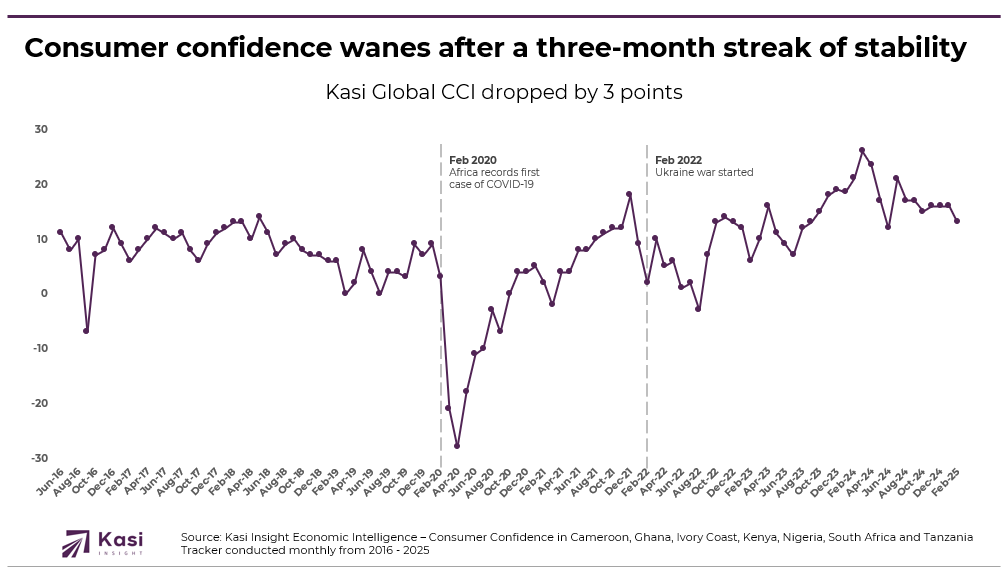
In February, consumer confidence in Africa declined by 3 points, breaking a three-month streak of stability. The drop was driven by a five-point decline in the future expectations index. However, the current conditions index improved by 4 points, indicating some resilience. While discretionary spending, household spending, and job prospects showed modest gains, declines in household income, personal finances, and overall economic conditions weighed on sentiment. The month reflected a mix of cautious optimism and increasing financial strain.
Household indices in February showed a mix of modest improvements and sharper financial setbacks. The discretionary spending index rose by 4 points, maintaining its momentum from January, while the household spending index edged up by 2 points, suggesting some continued but cautious consumer activity. The job prospect index also improved by 4 points, indicating that some consumers remain hopeful about employment opportunities. However, these gains were relatively small and did not translate into broad financial relief.
However, financial pressures intensified, signaling growing strain on household budgets. The household income index fell by 7 points, marking a sharper decline than in January, while the personal finance index dropped by 6 points, pointing to worsening financial stability among consumers. Despite improving job prospects, financial constraints are limiting household purchasing power, likely forcing consumers to be more selective in their spending or rely on alternative financial strategies such as credit or savings.
Adding to these concerns, broader economic sentiment deteriorated significantly. The general country economic conditions index plummeted by 9 points, while the general city economic conditions index declined by 7 points, reinforcing growing uncertainty about the economic landscape. While some indices showed resilience, the overall trend suggests that household confidence is weakening, with consumers bracing for continued financial strain in the months ahead.
Consumer confidence in Africa declined by 3 points in February, marking the first drop after three months of stability. While the current conditions index improved by 4 points, the future expectations index fell by 5 points, signaling rising uncertainty. Spending patterns showed signs of strain despite modest improvements in some areas. Discretionary spending increased by 4 points, household spending edged up by 2 points, and job prospects improved by 4 points. However, these gains were overshadowed by a steep 7-point drop in household income and a 6-point decline in personal finances, highlighting worsening financial pressure on consumers. Lower incomes and weaker personal finances are restricting household budgets, making it difficult for many to maintain previous spending levels.
The broader economic sentiment also weakened. The general country economic conditions index dropped by 9 points, while the general city economic conditions index fell by 7 points, reinforcing growing financial uncertainty. Consumer confidence declined in Ghana, Ivory Coast, Kenya, South Africa, and Tanzania, while Cameroon and Nigeria recorded improvements. Tanzania saw the sharpest decline, falling by 14 points, signaling worsening economic distress, while Cameroon had the strongest improvement, rising by 12 points. These shifts suggest that brands need localized strategies. In markets experiencing economic hardship, consumers will be drawn to affordable essentials, flexible purchasing options, and products that help them manage financial stress. In more stable markets, consumers may still engage with long-term value propositions and forward-looking messaging.
Consumers are not just cautious; many are being forced to cut back on spending altogether. The focus is shifting from selectivity to necessity, with non-essential purchases increasingly deprioritized. Brands must recognize that affordability alone is not enough. Reliability, cost-effectiveness, and practical solutions that make daily life easier will resonate the most. Offering long-lasting products, refillable and reusable options, or bundled solutions that reduce overall costs can help consumers navigate financial pressures while still engaging with brands. Consumers are also looking for reassurance and trust, which means brands that provide transparent pricing, strong customer support, and financial planning tools will stand out. As financial strain deepens, brands that offer stability and practical value will be best positioned to maintain consumer engagement and loyalty in a shifting economic landscape.
Share on socials using this caption: 📉 Consumer confidence in Africa dropped by 3 points in February, breaking a three-month streak of stability. While current conditions improved, future expectations declined, signaling growing financial uncertainty. Household income and personal finances weakened, reinforcing cautious spending habits. 💡💰 #ConsumerConfidence #AfricaEconomy #FinancialResilience
1412 views
Share article
Trust Is Becoming Economic Infrastructure
Consumer confidence loses momentum in October
Confidence plateaus in September as caution defines household behavior