Maps & Infographics
July 11, 2025
Share


This analysis sheds light on the evolving relationship between G7 nations and African countries, highlighting both the goodwill that exists and the gaps that need bridging. Understanding how Africans perceive and understand the G7 is critical for shaping more impactful, equitable partnerships in the years ahead.
On average, Africans score 2.79/5 on familiarity with the G7 - only “moderately familiar.” Many lack a clear sense of the G7’s activities, roles, or initiatives. Yet, perceptions remain largely positive. The G7 averages 3.24/5 on fairness, respect, and honesty. This means that even when people don’t fully understand the G7’s work, they tend to view it in a favorable light. This is likely driven by historical ties, global reputation, or visible local projects.
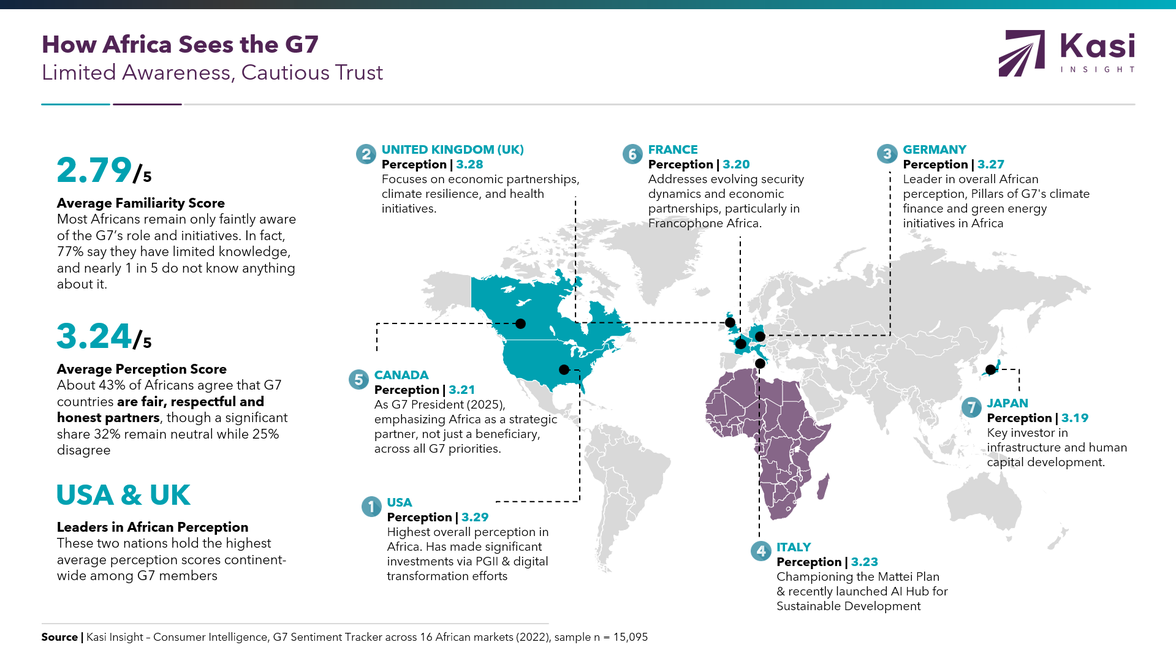
The United States (3.29), UK (3.28), and Germany (3.27) emerge as the most positively regarded G7 members across Africa. These views often link back to tangible investments - from U.S.-led PGII projects to German-backed green energy and climate finance. Africans notice when initiatives deliver visible results, and this recognition strengthens goodwill.
Still, this positive ground is fragile. Other global players, especially China, continue to expand their influence, often being perceived as pragmatic partners who “build without lectures.”

Uneven Perceptions Across African Nations
Perceptions of the G7 are not uniform across the continent. Countries like South Africa (4.40 APS) and Egypt (3.75 APS) exhibit remarkably high trust levels and positive views. In contrast, nations such as Nigeria (2.77 APS), Morocco (2.71 APS), and Algeria (2.82 APS) reflect more cautious or distant attitudes. These differences stem from diverse experiences, some shaped by visible investment and respectful diplomacy, others by lingering colonial ties, economic frustrations, or unmet expectations.
To strengthen Africa–G7 partnerships, three shifts are critical:
Transparency & Accountability | As G7 ODA faces significant cuts into 2026, the focus must shift from traditional aid to transparent, investment-driven partnerships. African governments and civil society must push G7 partners for clearer, more accessible information about their engagements, ensuring trust is rooted in understanding and demonstrable impact.
Equitable & Relevant Partnerships | African nations can leverage their growing agency (AU in G20, BRICS expansion) to negotiate more balanced, co-created agreements. G7 members must prove their long-term relevance by ensuring investments create lasting local impact, support skills transfer, and align with Africa’s long-term ambitions for industrialization, climate resilience, and equitable critical mineral value chains.
Beyond Competition | In an era of increased competition from other global players, the G7's true strength won’t be in outspending or outcompeting rivals, but in genuine partnership: co-creating solutions, respecting sovereignty, and aligning with Africa’s long-term priorities in industrialization, climate resilience, and fair critical mineral value chains.