Paul Cheloti Mulongo
July 18, 2025
Share article



Kasi Insight’s Share of Wallet Tracker provides a comprehensive view of how households in Tanzania allocate their spending, revealing patterns in income sources, monthly expenditures, and purchase behavior. According to Q2 2025 data, food and groceries account for a significant portion of household budgets. Over half of surveyed households report spending between 11% and 30% of their monthly income on this essential category. Specifically, 32% allocate between 11% and 20%, while 27% spend between 21% and 30%. An additional 15% report spending between 31% and 50%, and 6% of households dedicate more than 50% of their monthly budget to food and groceries.
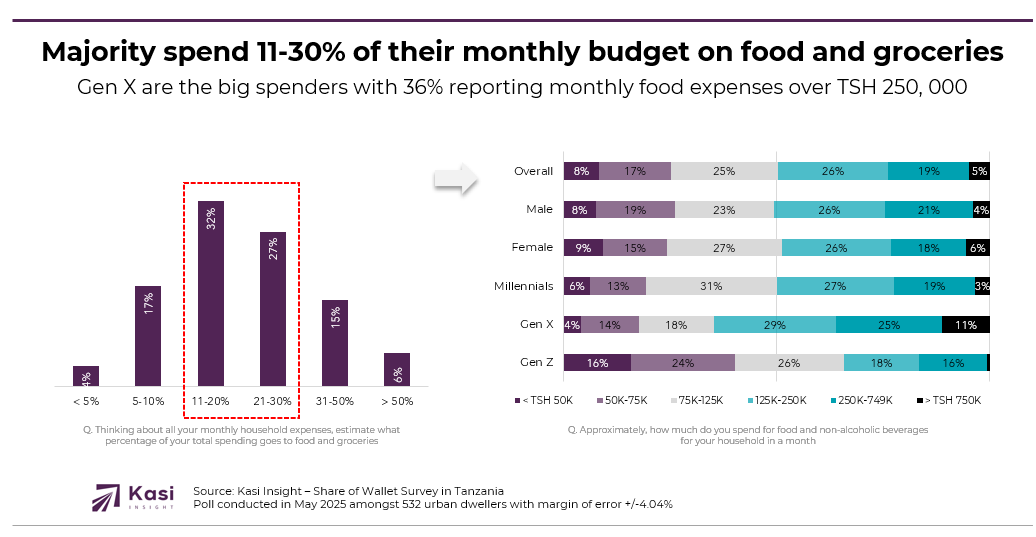
However, closer look at absolute monthly spending reveals sharp generational differences. While the most common monthly food expenditure falls between TSH 75,000 and TSH 250,000 overall, Gen X stands out as the highest-spending cohort. Over a third (36%) of Gen X respondents report spending more than TSH 250,000 per month, including an outsized 11% who spend over TSH 750,000 a rate more than triple that of any other generation. In contrast, Gen Z operates under tighter constraints, with 40% reporting monthly food spending below TSH 75,000. These figures point to clear affordability pressures among younger Tanzanians.
When it comes to the factors that drive purchasing decisions, price and affordability top the list for most consumers. This aligns with household spending patterns and confirms that cost remains a critical concern in the current economic climate. Product quality consistently ranks second across segments, indicating that while consumers are cost-conscious, they are not willing to compromise entirely on quality.
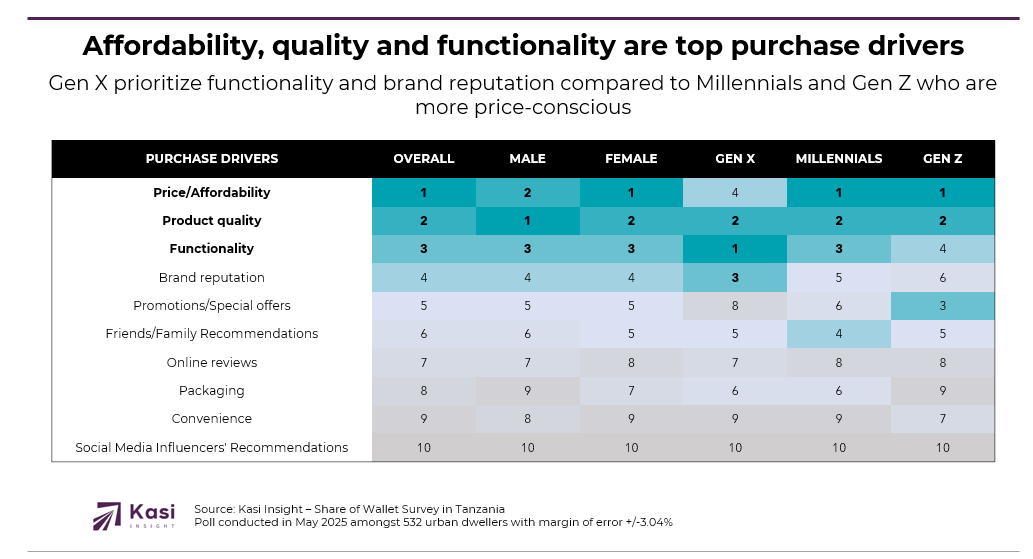
Generational nuance plays a defining role. For Gen X, functionality is the leading purchase driver, moving price down to fourth place. This group places higher value on utility than on affordability alone. In contrast, Gen Z shows greater sensitivity to promotions and special offers, which they rank as their third most important driver. This is significantly higher than Millennials who place it in sixth position and Gen X who rank it eighth. Although price remains important for all groups, Gen Z is especially responsive to time-bound deals and incentives. Across all age groups, recommendations from social media influencers have the least impact, reflecting a consumer mindset that prioritizes tangible benefits such as price, quality, and functionality over image-based cues.
Success in Tanzania’s food and beverage market depends on aligning price and quality with generational priorities. The significant portion of household income dedicated to food, combined with the dominance of price as a purchase driver, means that value is not just a preference but a necessity for most. Brands must anchor their strategies in affordability to remain relevant. However, true market leadership requires a more nuanced approach that speaks to the distinct priorities of each generation.
For brands targeting Millennials and Gen Z, the path to growth is paved with clear value propositions. This means optimizing price points, perhaps through smaller package sizes that offer a lower absolute cost and leveraging targeted promotions. For Gen Z in particular, digital-first campaigns featuring special offers and discounts can effectively capture their attention and drive trial. These younger consumers are navigating tighter budgets, and brands that help them stretch their shillings will earn their loyalty.
Conversely, Gen X offers a premium-ready audience but only if value is communicated through product performance. Marketing strategies for this segment should highlight durability, functional benefits, and premium ingredients. Whether it’s how long the product lasts, how it simplifies daily routines, or how it improves health and well-being, Gen X wants to see proof that a product earns its price.
Share on socials using this caption: 🍽️💡Tanzanian consumers are spending a big share of their income on food, but they are making every shilling count. Price and quality still lead, but Gen X prioritizes functionality 🔧 while Gen Z responds to promos and deals 🎯. Brands must balance affordability with purpose to stay relevant. #ConsumerSpending #FoodChoices #GenZTrends #GenXPriorities #ValueDriven #KasiInsight
1456 views
Share article
Nigeria’s alcoholic beverages market shows resilience in beer but steep H1 declines in premium categories
Fresh staples stay strong as Nigeria’s food market splits between value seekers and quality spenders
Ugandans are loyal to beer but wine captures the biggest spend